Word Solitaire-Unscramble Puz
Mindful Daily PuzzlesWord
4.8252.00 Reviews
- Version
- 1.83.1
- Installs
- 100.00K
- Age Rating
- Everyone
Screenshots
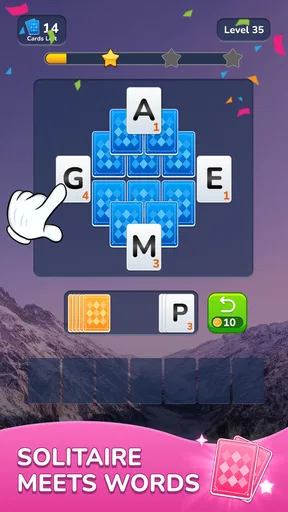
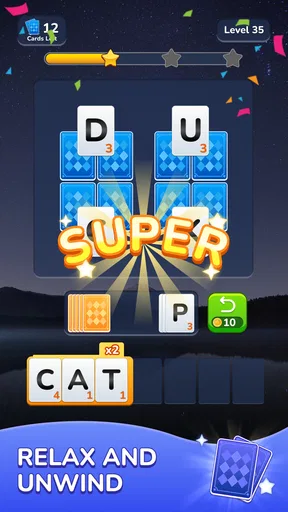
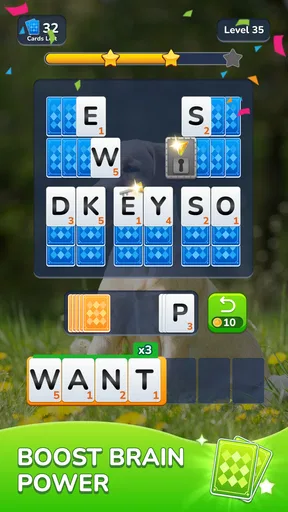
Our Review of Word Solitaire-Unscramble Puz
 Analysis by Appyee
I approached Word Solitaire-Unscramble Puz as a small daily game rather than a title meant to dominate an entire evening. That distinction matters. It combines word solving with solitaire-style play, so its appeal comes from switching between language and card-puzzle thinking instead of offering a single, deep word-game format. After spending time with it, I see it as a gentle option for short breaks, quiet mornings, and anyone who likes puzzles that ask for attention without feeling aggressive.
The game is free to start, suitable for Everyone, and comes from Mindful Daily Puzzles. Its store presence is already fairly strong, with a 4.8 average from around 3.6 thousand ratings and more than 100 thousand installs. Those figures suggest that the basic idea has found an audience, but they do not remove the need to decide whether this particular blend suits your habits. I would not choose it simply because it is popular. I would choose it if I wanted a word game with a calmer, card-based rhythm.
How to decide if this word-and-card format suits you
I’d judge the format by whether switching between word recognition and card planning feels refreshing, rather than expecting either half to behave like a full standalone game. Give it a few short sessions at different moments of the day; that makes it easier to tell whether its calm rhythm fits your routine or only seems appealing at first. The next question is how that rhythm holds up in practical use.
The right question is what kind of thinking you want
Many word games are built around speed, streaks, or finding the largest possible word before a timer ends. Traditional solitaire, by contrast, is usually about arranging cards and planning several moves ahead. This game sits between those expectations. The word element gives each round a vocabulary angle, while the solitaire influence makes the experience feel more deliberate than a rapid-fire anagram challenge.
That makes my first decision criterion simple: do you enjoy alternating between recognition and planning? If you prefer pure crossword-style clues, this may feel indirect. If you want classic solitaire with no language component, the word layer may interrupt the flow you enjoy. The game is most convincing for players who like both categories but do not need either one to be completely traditional.
I also paid attention to the kind of session it encourages. The format works naturally in small portions. I can imagine opening it while waiting for an appointment, playing a few rounds during a coffee break, or using it as a low-pressure activity before bed. It does not demand the same commitment as a long strategy game, and it is less twitchy than many modern casual puzzles. Its strongest quality is the way it turns a few spare minutes into a focused pause.
What to check before making it a daily habit
Free access is an important part of the decision, but the presence of in-app purchases means I would still approach it with a little awareness. Optional items range from $0.99 to $49.99 each. That is a wide enough range that I would avoid tapping purchase buttons casually, especially if I were handing the device to a child. The Everyone rating describes the intended age suitability, but it does not replace sensible purchase controls on a shared phone or tablet.
The technical entry point is also reasonably broad. The current version is 1.83.1 and requires Android 7.1 or later, so people using an older Android device should check compatibility before planning around it. I would not treat the version number as a promise of a particular feature set; it is simply a sign that the app is maintained as an ongoing product rather than a one-off experiment.
Another useful criterion is tolerance for repetition. Word-and-solitaire games can be relaxing precisely because their rules are easy to return to, but that same familiarity can become predictable. I would recommend trying the free experience long enough to see whether the combination continues to feel satisfying after the initial novelty. Players who need a strong story, elaborate progression, or constant visual change may lose interest sooner than people who enjoy a dependable puzzle routine.
Who will get the most from it
I think it is particularly well suited to casual word-game players who want something less intense than competitive anagrams. It can also work for someone returning to mobile games after a break, because the concept is easier to understand than a large strategy system. The card connection gives the word puzzles a familiar frame, while the language side adds enough variety to stop the experience from being ordinary solitaire.
It may be a comfortable choice for families looking for an Everyone-rated game, provided adults handle purchase settings and decide whether the style is appropriate for the individual child. The useful point here is not only age labeling; it is the low barrier to understanding the central activity. A player does not need to learn a complicated fictional world before getting started.
I would be more cautious about recommending it to advanced word-game fans who want difficult clues, precise vocabulary training, or a competitive leaderboard culture. Nothing about the core concept makes it a substitute for a serious crossword app or a dedicated anagram challenge. Its value is balance and accessibility, not specialist depth.
Where the game wins in everyday use
For me, its everyday strength is being easy to pick up when I have a natural pause and easy to put down when that pause ends. I’d treat it as a small transition between tasks, not as a substitute for every kind of downtime. That distinction helps clarify what the game does well—and where a different puzzle might be a better match.
The hybrid format creates a better break than either activity alone
The most convincing part of the design is the pairing itself. Solitaire can become repetitive when every decision follows the same card logic, while a word scramble can feel mentally narrow when every round asks for quick vocabulary recognition. Combining the two gives me a reason to change gears. I am not only searching for letters, and I am not only scanning card positions; I am moving between two kinds of attention.
That makes it useful in a realistic everyday scenario. Imagine finishing lunch with ten minutes before the next task. A competitive game might leave you more stimulated than relaxed, while a long puzzle might be difficult to start and stop. This title fits that gap: I can play a short session, concentrate on the immediate arrangement, and put the phone away without needing to remember a complicated campaign.
There is also a subtle benefit in using it as a transition activity. I would choose it after work when I want to stop checking messages but am not ready to sit in complete silence. The word component gives my mind something concrete to hold, and the solitaire structure encourages me to consider the next move rather than rush through every interaction. That is a more specific use case than simply calling it “relaxing.” It is a good bridge between passive screen time and more demanding entertainment.
It is approachable without being completely empty
Some simple mobile games are easy to launch but offer so little decision-making that they become background noise. This one has more substance because two puzzle habits meet in one place. Even when a round is not especially difficult, I still have to notice available word possibilities and think about how the card arrangement affects the next step. The result is modest, but it is not mindless.
I also like that the game does not need to be treated as a test of vocabulary. I can play for the process of spotting patterns rather than for a perfect performance. That distinction makes it friendlier to casual players and to people who enjoy language but do not want every mistake to feel like a failure. If I were introducing a friend to mobile word games, this would be easier to suggest than a highly competitive title with a steep learning curve.
My practical tip is to play it when you have a defined stopping point. A short break, a commute segment, or the final few minutes before sleep gives the game a natural boundary. Without that boundary, even a calm puzzle can become another reason to keep looking at a screen. The format supports brief use well, but the responsibility to stop still belongs to the player.
Small habits can make the puzzle side more rewarding
One non-obvious way to use it is as a vocabulary warm-up rather than a full entertainment session. I would look for a few possible word patterns, pause before committing to the first obvious answer, and treat the round as a chance to notice familiar letter combinations. This is not the same as formal language study, and I would not present it as an educational replacement. Still, the word-solving element can make a routine break feel more mentally active.
A second useful habit is to resist playing on autopilot. Because the solitaire influence feels familiar, it is easy to make the first available move without considering what it opens or blocks. I found the experience more satisfying when I treated each move as a small planning problem. That approach is especially helpful for players who normally find casual word games too easy: the challenge comes less from rushing and more from choosing carefully.
A third trade-off is session length. Longer play can be enjoyable when I am in the mood, but the repeated structure becomes more noticeable over time. I would rather use the game as a recurring short ritual than expect it to carry a whole evening. That is not a flaw for its intended audience; it is a boundary worth understanding before comparing it with larger puzzle collections.
What the developer’s positioning gets right
Mindful Daily Puzzles is a fitting developer name for this particular concept because the game’s best use is measured and repeatable. I would not describe it as a dramatic brain-training system, and I would be skeptical of anyone promising major cognitive results from ordinary play. What I can say is that the combination gives me a structured way to focus for a few minutes, which is a realistic and useful benefit.
The store summary presents the game as a way to boost the brain and relax through word games and solitaire. In my experience, the relaxation claim is more convincing than any broad promise about mental improvement. The game asks for attention, but it does not turn that attention into pressure. That makes it a good fit for casual mindfulness through play, as long as the player understands that enjoyment and concentration are the practical outcomes.
Where another type of app may fit better
The main trade-off is focus: a specialist word game can offer a more direct language challenge, while classic solitaire keeps attention on cards alone. I’d switch if I repeatedly wished one side of this blend would disappear, or if I wanted deeper progression than a compact routine provides. Choosing another format is not a knock on this one; it is a way to match the puzzle to the mood.
Choose a dedicated word game for depth and language challenge
If your main goal is vocabulary growth, spelling practice, or difficult clue solving, I would look toward a dedicated word-game category instead. A crossword-focused app is usually a better match for clue interpretation. A pure anagram game is likely to feel more direct if you enjoy rapidly testing letter combinations. A word board game may be preferable if you want a stronger competitive or strategic layer built around word placement.
The advantage of those alternatives is focus. They do not ask you to divide your attention between language and card movement. That can produce a deeper experience in one area, even if it loses the gentle variety I enjoy here. The choice depends on whether you value a mixed routine or want a specialist tool.
Choose classic solitaire for a cleaner card experience
Players who already love solitaire may find a traditional version more satisfying. A dedicated solitaire game keeps the rules and visual logic centered on cards, which makes it easier to settle into a familiar rhythm. If the word element feels like an interruption rather than a welcome change, there is little reason to force yourself to adapt.
This title wins only when the language layer adds interest. I would therefore test my reaction to the first sessions honestly: am I enjoying the combination, or am I merely tolerating one half while waiting for the other? If the answer is the latter, classic solitaire is the better choice, even if this game has a strong average rating.
Choose a larger puzzle collection for variety
Some players want one app that includes logic grids, number puzzles, crosswords, matching games, and daily challenges. A broad puzzle collection may offer more variety than this focused word-and-card format. It can also be better for households where different people want completely different puzzle styles.
The trade-off is that a larger collection can feel busier. Menus, multiple systems, and several kinds of progress may add friction when all I want is a quiet round. Word Solitaire-Unscramble Puz is easier to understand as a single-purpose habit. I would choose the collection for breadth and this game for a more consistent mood.
Who should probably skip it
I would skip it if I wanted a narrative adventure, a fast competitive match, or a sophisticated long-term strategy game. It is also not my first recommendation for someone who dislikes card mechanics or gets frustrated when a word puzzle does not feel immediately transparent. The blend is the reason to install it, so disliking either half weakens the case considerably.
I would also think twice if I am trying to reduce casual phone use. A free, repeatable puzzle can be a healthier-feeling distraction than social scrolling, but it is still screen time and still designed for repeated play. Setting a personal limit before opening it is more sensible than assuming a relaxing mood automatically makes unlimited use worthwhile.
The cost of switching and what to expect from free play
Because it is free to start, trying the game is a low-commitment way to test whether the hybrid suits you, but free play still calls for thoughtful boundaries around optional purchases. I’d decide in advance whether I’m willing to spend and avoid treating a purchase as necessary before I understand its value. With that practical check in mind, the remaining decision is whether it deserves a regular place on your device.
Starting is easy, but purchases deserve attention
The free price lowers the risk of trying the game. I can see whether the word-and-solitaire combination works for me without committing money at the outset. That is valuable because the central question is personal taste, not technical capability. No description can tell me whether the rhythm feels calming or repetitive; a short trial can.
At the same time, in-app purchases from $0.99 to $49.99 per item create a meaningful difference between “free to try” and “free with no spending considerations.” I would review purchase protections before letting a child use the game and would avoid buying anything until I understood what problem the item solves. If a purchase is meant to remove a temporary obstacle, I would ask whether that obstacle is part of the intended puzzle experience or simply a source of impatience.
This is also where switching costs matter. If I move from a pure word game, I may need a little time to appreciate the card decisions. If I move from solitaire, I need to accept that finding words changes the pace. There is no complicated conversion process, but there is a mental adjustment. The game rewards curiosity more than loyalty to one established puzzle tradition.
What I would do before committing to regular use
I would begin with several short sessions rather than one long test. In the first session, I would focus on whether the controls and basic loop feel understandable. In the next, I would notice whether the card element improves the word play or merely slows it down. In another, I would deliberately stop after a brief break and ask whether I wanted to return because the puzzle was satisfying or because the app was simply available.
That test helps answer a practical question many readers have: will it remain interesting after the first day? For me, the answer depends on expectations. It has a good chance of becoming a pleasant daily routine if I like repetition with small variations. It is less likely to hold me if I need escalating complexity or a strong sense of completion.
I would also check the device requirement before recommending it to someone with an older phone. Android 7.1 is the minimum operating system, and the current release is 1.83.1. Those details are easy to overlook when an app looks lightweight, but compatibility is part of the real installation decision.
My recommendation after weighing the alternatives
I’d keep it installed if its short, measured rounds make ordinary gaps in the day feel more engaging without turning into a habit I resent. If I wanted a harder word challenge, unmodified solitaire, or a broader puzzle library, I’d choose that alternative instead. My recommendation comes down to a simple test: does the combination make you want to return for the experience itself?
Install it if you want a calm hybrid puzzle
I recommend Word Solitaire-Unscramble Puz to people who want a free, approachable word game with a solitaire influence and a relaxed pace. Its best quality is not that it revolutionizes either category. It is that it makes the two work together well enough for a short, repeatable mental break. I can imagine keeping it available for waiting rooms, quiet mornings, and those moments when I want something more active than scrolling but less demanding than a full game.
The Everyone rating makes it broadly approachable, and the 4.8 average from around 3.6 thousand ratings gives the game a reassuring starting point. More than 100 thousand installs also show that it is not an obscure experiment. Still, I would treat those figures as context rather than proof that it will suit every player. The real deciding factor is whether the hybrid structure feels like variety or compromise to you.
Keep your expectations realistic
I would not install it expecting a complete replacement for crossword puzzles, serious vocabulary training, or classic solitaire. I would install it for a compact routine that combines letter recognition with card-based planning. That is a narrower promise, but it is also the one the game can meet most honestly.
My final advice is to try the free experience with a clear purpose: use it for short sessions, watch how quickly repetition sets in, and keep purchases deliberate. If the combination helps you settle into a focused break, it is an easy recommendation. If you find yourself wishing for harder clues, purer solitaire, or a wider collection of puzzles, switch categories rather than trying to make this game become something it is not. For the right player, its simplicity is the feature—not a limitation to overlook.
Verdict
Strengths of Word Solitaire-Unscramble Puz
- Combines solitaire with word puzzles for varied gameplay.
- Simple controls make it easy to start playing immediately.
- Short rounds are convenient for quick gaming sessions.
- Word challenges can help expand vocabulary and spelling skills.
- Relaxing pace suits players who prefer casual puzzle games.
Limitations of Word Solitaire-Unscramble Puz
- Difficulty may feel uneven as word puzzles become more complex.
- Limited gameplay variety can make sessions feel repetitive over time.
- Some levels may depend heavily on knowing uncommon words.
- Hints or extra moves may be restricted without watching ads.
- Players seeking competitive multiplayer features may find it lacking.
Other Releases by Mindful Daily Puzzles
View All
Mahjong Master: Daily Match
Puzzle4.9
Similar Picks in This Category
View All
Word Search - Word Puzzle Game
Bluetile4.8

Word Search Quest - Puzzles
Blackout Lab4.8

CodyCross: Crossword Puzzles
Fanatee, Inc.4.7

Words of Wonders: Crossword
Fugo Games4.9

Wordscapes: Word puzzle game
PeopleFun4.7

Word Search Explorer
PlaySimple Games4.9
Frequently Asked Questions
What is Word Solitaire-Unscramble Puz?
Word Solitaire-Unscramble Puz is a word puzzle game that combines classic solitaire-style card play with unscrambling challenges. You arrange letters, form valid words, and complete levels while working through progressively more difficult puzzles. The format is designed for short sessions, making it suitable for casual play, vocabulary practice, and relaxing gameplay without requiring advanced gaming experience.
How do you play Word Solitaire-Unscramble Puz?
The main objective is to uncover and arrange letter cards to create words, using the available cards strategically in a solitaire-inspired layout. You generally need to plan your moves carefully because revealing or using the wrong letter can limit your options. As levels progress, the puzzles become more challenging and may require better vocabulary, pattern recognition, and forward planning.
Is Word Solitaire-Unscramble Puz free to download and play?
The game can generally be downloaded for free, although the exact availability of optional purchases, advertisements, or premium features may depend on the version and platform. Free gameplay may include ads between or during levels, while purchases could provide hints, remove advertising, or offer additional resources. Before downloading, check the store listing for current pricing and in-app purchase details.
Does Word Solitaire-Unscramble Puz require an internet connection?
Many casual puzzle games allow at least part of the gameplay to work offline, but certain features may require an internet connection. Advertising, cloud synchronization, updates, leaderboards, rewards, or purchase verification can depend on online access. If you plan to play while traveling or without mobile data, test the game after installation and confirm which modes remain available offline.
Is Word Solitaire-Unscramble Puz suitable for all ages?
Word Solitaire-Unscramble Puz is generally suitable for players who enjoy word games and simple card-based puzzles, including older children, teenagers, and adults. However, the appropriate age rating can vary by platform because of advertising, optional purchases, or other content included in the app. Parents should review the store rating and consider enabling purchase restrictions for younger players.
Play our best games!


